Concerns Increase over the Too Frequent Burning of our Bush

By Neil R Marriott

In an interesting feature article in the June ‘Parkwatch’, Phil Ingamells states that “evidence against Victoria’s fuel reduction program is clear, yet burns are increasing. Calls for a pause and re-assessment of fire management are growing louder”. The most alarming result of “fuel reduction” burning is often fuel production burning!

The next most alarming thing is that the state government department that plans and performs those burns does no monitoring of what actually happens afterwards. Anyone marketing a car, a vaccine, or building cladding would be expected to know how it performs over time, whether it’s safe, and, of course, if it actually works. However, Victoria’s Department of Environment, Land, Water and Planning (DELWP) doesn’t return to the site of its fuel reduction burns and record what has eventuated – not after one year, not two or, most importantly, not a decade or so into the … Read the rest
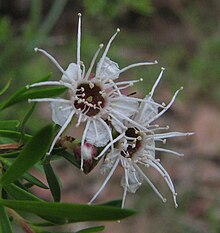
A New Weed Species to watch out for – Kunzea leptospermoides

(adapted from the Project Platypus Newsletter)

Project Platypus is working closely with Halls Gap and surrounding communities to control the spread of Kunzea leptospermoides (Yarra Burgan) and the threat it imposes on the Grampians National Park and surrounding reserves.

Kunzea leptospermoides

Yarra burgan (Kunzea leptospermoides, previously K. ericoides) is a tall (2-5 [<15]m) native shrub originating from eastern Victoria and the NSW coastal hinterland. It is not indigenous to Halls Gap or the Grampians National Park. Yarra Burgan was introduced to the region as an ornamental garden plant and has since spread forming dense thickets which are a biodiversity threat and fire hazard.

Yarra burgan was initially thought to be a similar species, Kunzea ericoides, from New Zealand, but studies revealed it as an Australian native. It is a highly successful species in part due to changes in climate and hybridization. Yarra burgan looks very similar to the … Read the rest

From the Editor

Welcome to our Autumn issue. Apologies that it is a bit late and has very short notice of our event next week, and it has no timetable of future activities. We may be doing so well against Covid compared to the rest of the world, but that certainly doesn’t mean smooth progress. Rules, rules. Plus, the pressures on staff with the management plan being due out soon, some illness in our committee and here we are!

In addition to group meetings, we are hoping to help Parks with some individual projects. Some of us have committed to updating some of the visitor information sheets, and we hope to assist in digitising the herbarium samples that were mostly collected by Ian McCann and the Stawell Field Naturalists. If you are one of those who volunteered to do these, how are you going? Do let Hannah know.

We would love to have … Read the rest

2021 May PRESIDENT’S REPORT or, as Rodney dubbed it, PREZ SEZ

Welcome to FOGG’s 1st newsletter for 2021, and to an action-packed year of activities …. except the action has been very slow to start with; post-Covid, health problems within the committee, computer glitches – and as Margo said, time pressure on Parks staff. We apologise for the lateness of notification of events so far, but I am providing a provisional calendar for the rest of the year (see below); although none of these activities have yet been approved by Parks. As soon as this happens, you will all be notified.

We have had two outings so far this year, with our third coming up on Saturday 8th May. After all the Restrictions last year, it has been wonderful to gather together again, see each other, welcome new members, and share our interests and knowledge.

Our February event, finding and looking at reptiles, led by David Steane (who has … Read the rest

UPDATE from the Parks Victoria Grampians Team May 2021

FROM RHONDA, OUR CHIEF RANGER, UPDATE from the Grampians Team

What a different Easter from last year back to full capacity so a busy time for all our team. One of our growing issues is waste management and this has unfortunately increased we believe over Covid due to the feeling of safety that comes with disposable items. But where to dispose of them. This Easter we placed a skip bin at Plantation Campground as in past years this is the campground where we have had the most rubbish left in bags at trees. Well, it certainly worked as the photo shows with the entire skip bin full and three large tandem trailer loads all around it. What to do is our next question as this is not sustainable with our budget.

Last week saw the departure of Derek Sandow. Derek was acting in the Team Leader Environment position and prior … Read the rest

From Hannah, Our Community Ranger May 2021

This week concludes the first ever Great Grampians Bird Survey – The GGBS! It has been an almighty 10 weeks delivering the Bird Ecology Course with Greg Kerr and a hugely successful weekend with Volunteers coming home with many beautiful bird stories. Volunteers completed 144 bird surveys this weekend at 36 remote sites across Gariwerd, the same sites from which Deakin University collect mammal data from each year. The data collected from Volunteers was entered into Birddata which is now accessible to the public. The aim of this project is to determine how effective the Grampians Ark project has been at controlling foxes and feral cats. Cat baiting began last year, however before this occurred, we contacted Dr Greg Kerr to collect base line bird data at the 36 mammal sites – which we can now call the mammal and bird sites. Greg returned to the same sites after the … Read the rest

The Great Gariwerd Bird Survey

FOGG first informed members back in March 2020 that Parks Vic were inviting up to 40 volunteers to partake in “The Great Gariwerd Bird Survey”, the beginning of systematic bird surveying in the national park. The survey was to be preceded by a 10-week course conducted by Glenelg Nature Trust’s senior ecologist Dr Greg Kerr.

Covid forced a delayed start, and it was not until early February 2021 that 20 volunteers met in Halls Gap and 20 in Dunkeld. The general format of each weekly course session was: meet at 5pm at various field locations for a spot of bird-watching, then back to the classroom for 2 hours of Greg presenting on various aspects of bird ecology (evolution, plumage, moulting, calls, migration etc.); in  the final hour he presented photos of bird species for attendees to identify. Not all species occurred in Gariwerd.

There were many interesting details presented during … Read the rest

Nature Glenelg Trust Wetland monitoring program

Just in is another message from Nature Glenelg Trust.

An exciting citizen science opportunity in the Grampians awaits You!

NGT is in the early stages of developing a volunteer-based wetland monitoring program to learn more about the ecological responses of two restored wetland systems in the southern Grampians.

The Walker, Gooseneck, and Brady Swamp wetland complex, and Green Swamp, have undergone significant hydrological changes over the past few years, with support and involvement from the community playing a key role. These works, which straddle Parks Victoria reserves and NGT’s wetland restoration reserves, have supported the recovery and conservation of a range of wetland dependent species such as fish, frog and birds, many of which are threatened. Equally, the transformation of these systems has provided new opportunities for the community to enjoy the local flora and fauna.

This citizen science monitoring program will allow community members to connect to these wetlands … Read the rest

Pest Control Conservation program in the Grampians (Gariwerd) National Park and Black Range State Park between March and October 2021

FROM ANDREW MCKINNON, AREA CHIEF RANGER March 2021

This is to inform you of a conservation program in the Grampians (Gariwerd) National Park and Black Range State Park between March and October 2021.

Heritage listed for its biodiversity and cultural values, the Grampians landscape is home to more than 800 indigenous plant species, a wide range of wildlife and the majority of Aboriginal rock art sites in south-east Australia.

To help protect this unique landscape, Parks Victoria regularly undertakes conservation programs to control invasive animals, including feral goats.

On a few days each month from 29 March until late October, a crew of qualified and experienced volunteer shooters will target these pest animals in remote sections of the parks.

During the operation, access to some sections of the parks will be temporarily restricted and people may be able to hear gunshots. Key visitor areas will not be affected… Read the rest

Southern Brown Bandicoot

Southern Brown Bandicoot

Sightings of the endangered Southern Brown Bandicoot have provided further encouragement for Park Rangers about the health of native animal habitat in the Grampians (Gariwerd) National Park.

The small species of bandicoot, listed as Endangered in Victoria, was detected on surveillance cameras that were placed in the national park following reports from a member of the public.

It’s the first recorded sighting by Park Rangers in two years and follows recent camera footage that confirmed an increase in the park’s small population of Brush-tailed Rock-wallabies, which are listed as Critically Endangered.

As with other animals in the area, it appears that bandicoots may be benefiting from a combination of recent factors including rainfall levels, a lack of large-scale bushfires and Parks Victoria’s conservation work, such as the Grampians Ark program.

Parks Victoria’s Grampians ark coordinator Derek Sandow said these sightings are really encouraging news for this native … Read the rest

Friends of Grampians Gariwerd