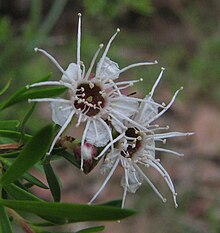
A New Weed Species to watch out for – Kunzea leptospermoides

(adapted from the Project Platypus Newsletter)

Project Platypus is working closely with Halls Gap and surrounding communities to control the spread of Kunzea leptospermoides (Yarra Burgan) and the threat it imposes on the Grampians National Park and surrounding reserves.

Kunzea leptospermoides

Yarra burgan (Kunzea leptospermoides, previously K. ericoides) is a tall (2-5 [<15]m) native shrub originating from eastern Victoria and the NSW coastal hinterland. It is not indigenous to Halls Gap or the Grampians National Park. Yarra Burgan was introduced to the region as an ornamental garden plant and has since spread forming dense thickets which are a biodiversity threat and fire hazard.

Yarra burgan was initially thought to be a similar species, Kunzea ericoides, from New Zealand, but studies revealed it as an Australian native. It is a highly successful species in part due to changes in climate and hybridization. Yarra burgan looks very similar to the … Read the rest

Nature Glenelg Trust Wetland monitoring program

Just in is another message from Nature Glenelg Trust.

An exciting citizen science opportunity in the Grampians awaits You!

NGT is in the early stages of developing a volunteer-based wetland monitoring program to learn more about the ecological responses of two restored wetland systems in the southern Grampians.

The Walker, Gooseneck, and Brady Swamp wetland complex, and Green Swamp, have undergone significant hydrological changes over the past few years, with support and involvement from the community playing a key role. These works, which straddle Parks Victoria reserves and NGT’s wetland restoration reserves, have supported the recovery and conservation of a range of wetland dependent species such as fish, frog and birds, many of which are threatened. Equally, the transformation of these systems has provided new opportunities for the community to enjoy the local flora and fauna.

This citizen science monitoring program will allow community members to connect to these wetlands … Read the rest

Pest Control Conservation program in the Grampians (Gariwerd) National Park and Black Range State Park between March and October 2021

FROM ANDREW MCKINNON, AREA CHIEF RANGER March 2021

This is to inform you of a conservation program in the Grampians (Gariwerd) National Park and Black Range State Park between March and October 2021.

Heritage listed for its biodiversity and cultural values, the Grampians landscape is home to more than 800 indigenous plant species, a wide range of wildlife and the majority of Aboriginal rock art sites in south-east Australia.

To help protect this unique landscape, Parks Victoria regularly undertakes conservation programs to control invasive animals, including feral goats.

On a few days each month from 29 March until late October, a crew of qualified and experienced volunteer shooters will target these pest animals in remote sections of the parks.

During the operation, access to some sections of the parks will be temporarily restricted and people may be able to hear gunshots. Key visitor areas will not be affected… Read the rest

Southern Brown Bandicoot

Southern Brown Bandicoot

Sightings of the endangered Southern Brown Bandicoot have provided further encouragement for Park Rangers about the health of native animal habitat in the Grampians (Gariwerd) National Park.

The small species of bandicoot, listed as Endangered in Victoria, was detected on surveillance cameras that were placed in the national park following reports from a member of the public.

It’s the first recorded sighting by Park Rangers in two years and follows recent camera footage that confirmed an increase in the park’s small population of Brush-tailed Rock-wallabies, which are listed as Critically Endangered.

As with other animals in the area, it appears that bandicoots may be benefiting from a combination of recent factors including rainfall levels, a lack of large-scale bushfires and Parks Victoria’s conservation work, such as the Grampians Ark program.

Parks Victoria’s Grampians ark coordinator Derek Sandow said these sightings are really encouraging news for this native … Read the rest

Grasslands: Biodiversity Of South-Eastern Australia App – Free App 2012

Australia’s native grasslands are some of our most critically endangered ecosystems, home to many endangered fauna and flora species. A new, free comprehensive field guide app for iPhone and iPad, Grasslands: Biodiversity of South-Eastern Australia, is now available. It introduces users to, and aims to build an appreciation of, the unique biodiversity of south-eastern Australia’s temperate native grasslands.

It is a collaboration between the University of Melbourne team that published Land of sweeping plains: Managing and restoring the native grasslands of south-eastern Australia and Ecolinc, a Department of Education and Training Specialist Science Centre focusing on environmental science curriculum programs for P–12 students and teachers.

For more information contact Associate Professor Nicholas (Nick) Williams, Urban Ecology and Urban Horticulture, School of Ecosystem and Forest Sciences, Faculty of Science, The University of Melbourne via email: .… Read the rest

WIN PIETSCH: An Inspiring Naturalist

A few years ago, when I was talking with Win Pietsch about the rich frog life in part of the Mt William Ck wetlands by our place, she replied: “Oh yes, Thelma and I were there the other night, we’ve been surveying it for years” … This really impressed me! Win’s keen interest in nature, and dedication to scientific research, resonated deeply; I also realised that, although she is still an active member, many current  FOGGies probably don’t  know much about the work of Win and her fellow enthusiasts – ‘citizen scientists’ – who over the years have added so much to our knowledge and understanding of the  nature around us.

This started the germ of an idea: to write this article! What follows is an abbreviated “CV” of an amazing naturalist.

One of the most rewarding aspects about going to FOGG outings is the wealth of shared expertise in … Read the rest

Insect Talk

February 7, 2020

It was very good to see over 20 people come to hear Denis Crawford speak on the importance of insects, and to enjoy his amazing photography of “creepy crawlies and bloodsuckers”.

Did you know that the world has 5,500 species of mammals, 10,000 of birds, 40,000 vertebrates and 1.25 million invertebrates, of which 1 million are insects?  Understandably we didn’t hear about all 1 million species but looked at some moths, bees and ants. Lots of fascinating snippets: I never knew that there was a moth that only feeds on dead grass trees. How specialised is that? What do insects contribute to the environment? They pollinate flowers, recycle and bury dung, eat or parasite other insects, provide food for other animals, disperse seed (and in various intriguing ways), aerate the soil. A reduction in insects would massively impact on flowering plants, lessen the food available for fish, … Read the rest

Grampians Rock Art In The News

EXCERPTS FROM AN ARTICLE IN THE AGE JAN 13

The AGE had a long and chatty article on a fascinating newly discovered art site. It is far too long to copy here, but I do recommend that you read it on line – The Age

Or you can contact me (Margo) and I can send it to you.  It is the need to protect valuable sites like this one that makes it so important to educate rock climbers, and where necessary ban some sites.

‘Now the legendary bunyip has been found – or ancient rock drawings of it at least – in a shallow cave atop a cliff in the Mt Difficult Range. Four bunyips, to be precise, lurking in a sandstone shelter on an outcrop that commands sweeping views of the plains of north-western Victoria.

It was a find that would shine new light on an age-old story – Read the rest

Nature Glenelg Trust News

The Upper Wannon River floodplain is adjacent to the Grampians National Park in western Victoria. A large proportion of this floodplain was drained from the 1950s for agriculture and later converted to a Tasmanian Blue Gum plantation forest. Nature Glenelg Trust (NGT) has been progressively working to restore the wetlands of the floodplain across public and private land, with successful permanent works now completed at Brady Swamp and Gooseneck Swamp in the Grampians National Park.

A recently awarded Victorian Government Climate Change Innovation Grant (via DELWP) is funding major on-ground works over the next two years that will see Walker Swamp transformed into a community demonstration site for sustainable floodplain restoration and management; by removing the plantations and reversing artificial drainage across the more than 440 hectares of land now owned by Nature Glenelg Trust.

These activities will restore natural river floodplain function, recreating wetland habitats for threatened and iconic … Read the rest

Deer Strategy

The Draft Victorian Deer Management Strategy (the draft strategy) has been developed by the Department of Environment, Land, Water and Planning (DELWP) and the Department of Economic Development, Jobs, Transport and Resources

The development of a deer management strategy is a key action under the Victorian Government’s Sustainable Hunting Action Plan 2016 – 2020 and recognised under the Protecting Victoria’s Environment – Biodiversity 2037 Implementation Framework.

The objectives of the draft strategy are to maintain hunting opportunities while managing the impacts of deer on environmental, social, cultural, economic and agricultural assets.

Effective deer management requires a partnership approach between all levels of Government, Traditional Owners, conservation and community groups, Landcare, water authorities, Catchment Management Authorities, hunting organisations, hunters, the deer farming industry, commercial deer harvest industry and the community.

The draft strategy proposes a new way of thinking to guide how deer are managed in our landscape.

Opportunity was … Read the rest

Friends of Grampians Gariwerd